info@rhenac.de
  +49 2242 9061 120
  DE
DE 

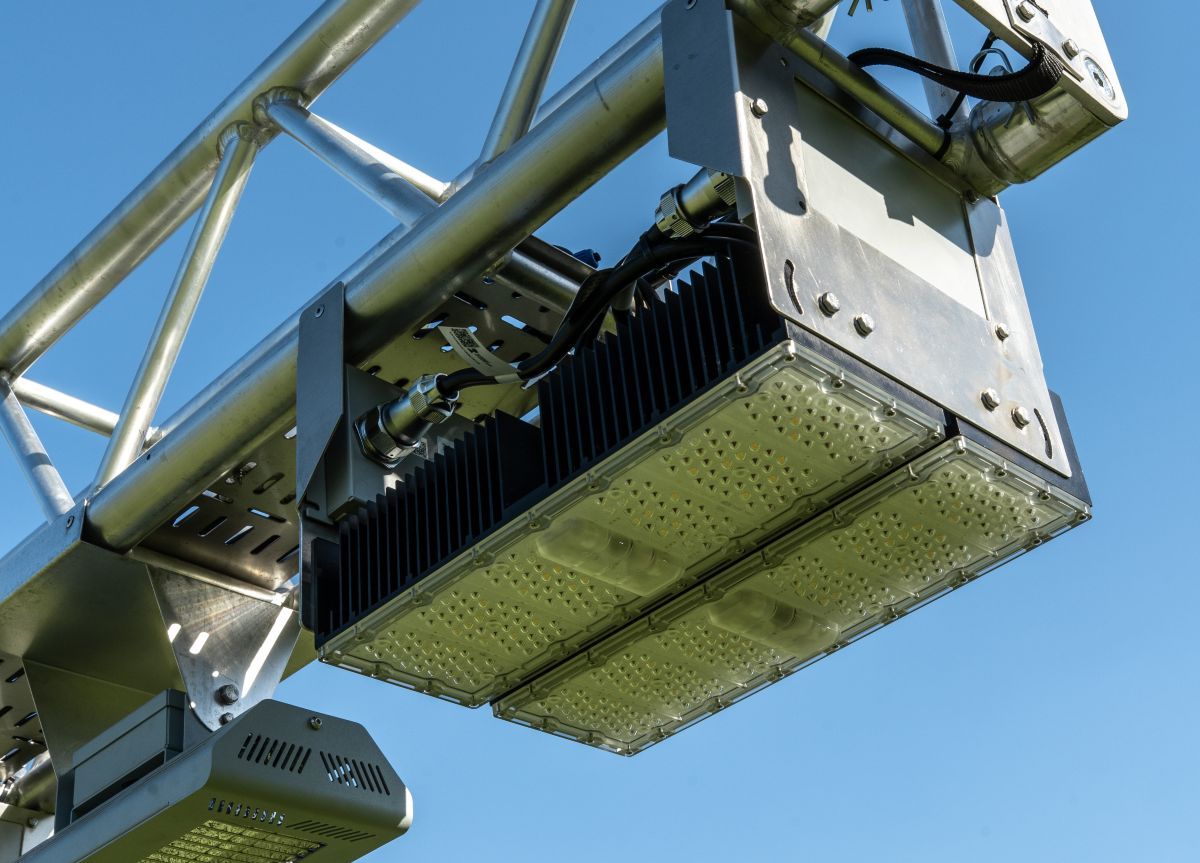
In modern turf management, the LED light colours have become more than just a maintenance tool — it’s a controllable growth factor rooted in biology. Complete Light Spectrum (CLS) technology represents the most advanced approach to understanding and replicating how plants respond to natural light.
Our systems reproduce every wavelength of sunlight — from ultraviolet to infrared — allowing precise control over how turf grows, strengthens and recovers. Each colour of light affects the plant in a specific way, and CLS enables these wavelengths to be adjusted individually, creating conditions that closely mirror nature.
CLS is the future of turf maintenance because it’s based on measurable data rather than assumption. By analysing the biological responses of turf to each wavelength, this full light spectrum for turf growth ensures grass receives exactly what it needs for every stage of its lifecycle.
To verify and refine this approach, Rhenac and its research partners have created several world-first facilities dedicated to studying the interaction between light and living systems:
- Europe’s first LED Growth Chamber – a fully controlled environment for precision turf and plant research.
- The world’s first LED Growth Mobile Container – a plug-and-research system enabling field testing under identical conditions.
- The world’s first Micro-Algae Indoor Farm (350 m²) – a complete concept demonstrating light-driven biological productivity.
- The world’s first 30-metre-deep Pitch Hypogeum [link] – an underground facility integrating systems that simulate natural environments.
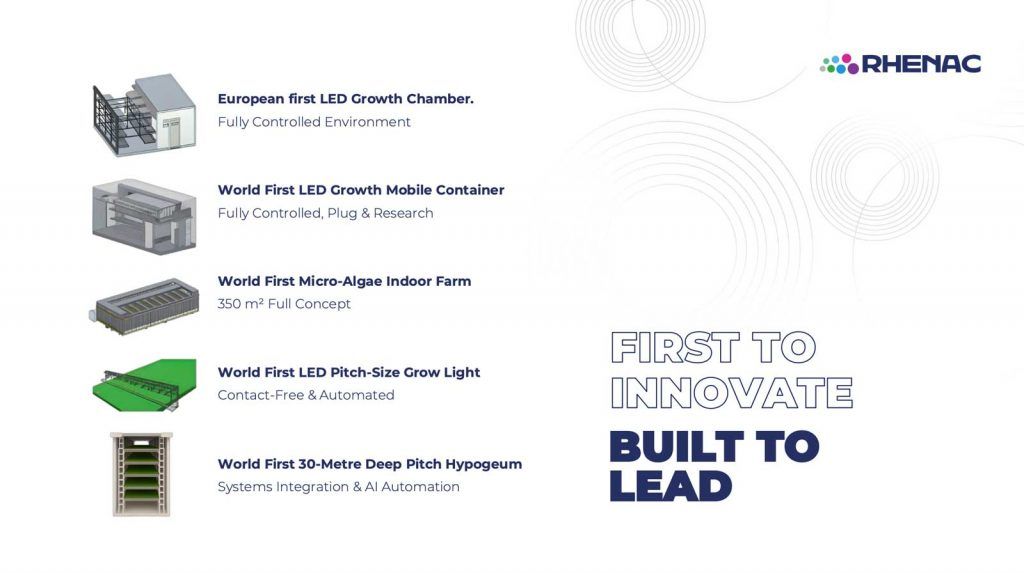
These research platforms make it possible to create CLS light recipes for precise maintenance of sports surfaces in elite stadiums around the world.
Understanding Natural Light and Turf Growth
A holistic approach to pitch regeneration and monitoring — integrating light, water, heat, airflow and climate management — represents a revolution in plant biological management.
This scientific approach recognises that turf performance depends on the dynamic relationship between several environmental factors. Among them, the quality and balance of LED light colours is the most critical: it powers photosynthesis, regulates plant hormones and determines the overall structure and strength of grass.
The Complete Light Spectrum uses all the colours of natural sunlight. Each LED light colour (wavelength) supports a different part of turf growth and recovery.
Think of sunlight as a balanced diet:
- Ordinary lights feed turf with one or two nutrients.
- CLS LED light provides the full menu, giving grass everything it needs to stay strong, healthy and consistent all year round.
The Role of Different LED Light Colours in Turf Growth
Each section of the light spectrum serves a distinct biological purpose. When applied in the correct proportions, these wavelengths allow turf to grow evenly, recover faster and resist stress more effectively.
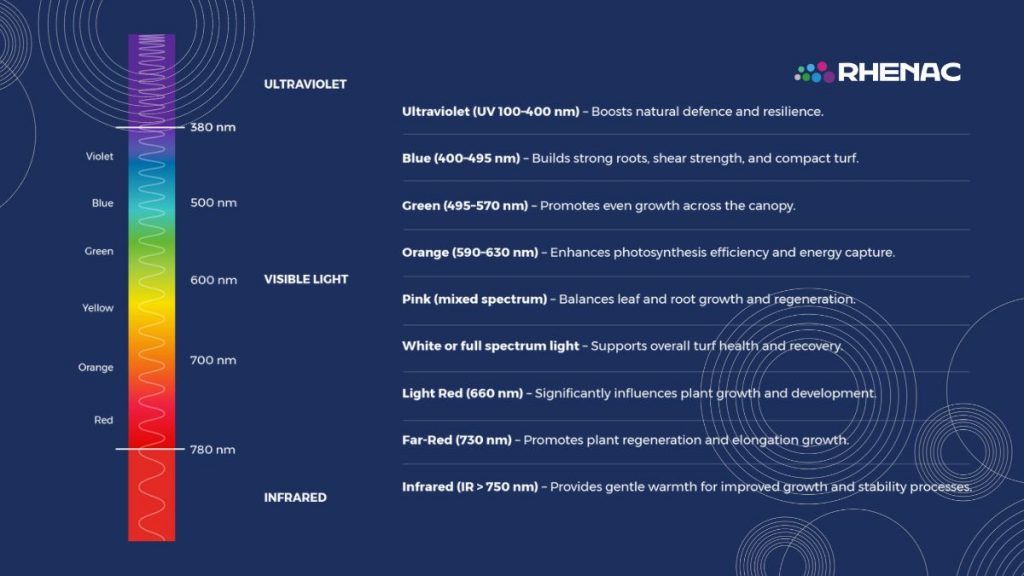
| Ultraviolet (UV 100–400 nm) | Strengthens cell walls and enhances stress tolerance. Reduces fungal activity and disease risk. Promotes protective compounds that build plant resilience. |
| Blue Light (400–495 nm) | Strengthens roots and shear resistance. Improves density and colour. Creates compact, resilient turf. |
| Green Light (495–570 nm) | Penetrates deeper cell layers (additional benefit for photosynthesis) Stimulates longitudinal growth |
| HPS / Yellow–Orange Light (550–630 nm) | Proven and dependable. Adds infrared warmth for growth in colder months and for drying wet turf. |
| Pink Light (Red + Blue) | Energy supplier (photosynthesis) to support: • Leaf and root development • Regeneration |
| White Light | Contains various light colors as a fixed blend Supports the overall health and recovery of the turf Familiar and widely used in turf lighting systems. |
| Far-Red Light (700–750 nm) | Sensed by plants rather than people. Stimulates germination, controls plant development (e.g., flowering), and the elongation of leaves and stems. Boosts regeneration when balanced with red light. |
| Infrared (IR > 750 nm) | Provides gentle warmth for growth in cooler conditions. Supports recovery after intensive use. Must be carefully regulated to avoid heat stress. |
When natural sunlight is limited — as in stadiums with closed roofs or shaded stands — the ability to reproduce and balance these wavelengths becomes essential for maintaining playing quality.
Balanced light spectrum management for turf growth ensures every part of the turf — roots, shoots and leaves — develops in harmony.
Research and Technical Validation
Independent studies, including research by the Technical University of Munich, have demonstrated how specific wavelengths influence turf growth and recovery. In controlled trials, scientists confirmed that ultraviolet and other parts of the spectrum can inhibit fungal development, accelerate recovery and enhance turf strength.
These findings form the scientific foundation of modern lighting technologies such as CLS, helping venues reduce chemical dependency and improve environmental sustainability.
Light is one of the most powerful tools in professional turf management.