info@rhenac.de
  +49 2242 9061 120
  DE
DE 

How LED Lighting Supports Turfgrass Root Physiology and Recovery in Modern Stadiums
1. Stadium Turf: The Problem Often Starts Below the Surface
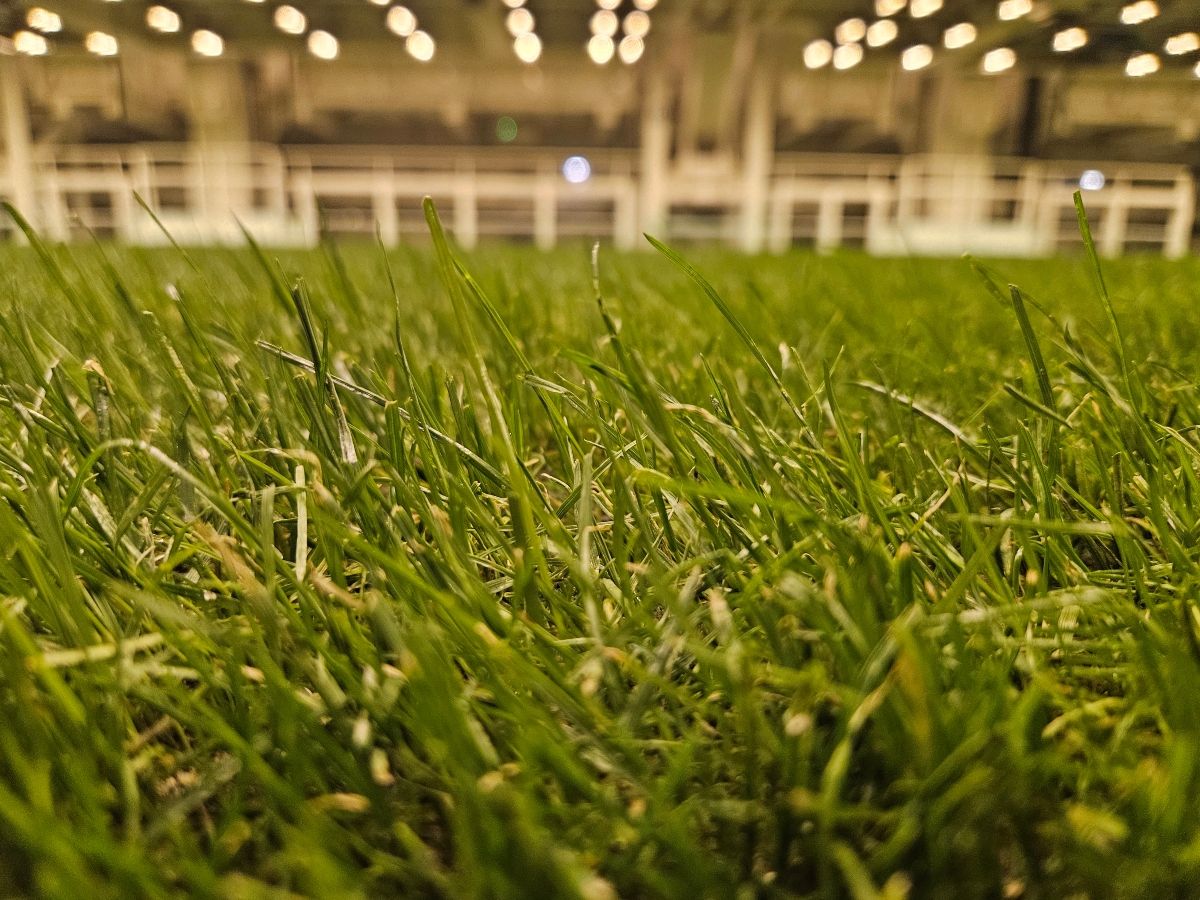
A football pitch can look green and healthy while physiological limitations are already developing below the surface. For professional stadium turf, the root system is essential for water and nutrient uptake, stress tolerance and recovery after intensive use.
Stadiums create challenging growing conditions. Roofs, stands and surrounding structures can reduce natural radiation, creating areas with very different light levels across the same pitch. Persistent shade can reduce photosynthetic activity, turf density, recovery capacity and root development.
The challenge is therefore not simply whether a stadium pitch receives light, but whether sufficient light reaches the canopy where and when the plant needs it.
2. Why Light Is Fundamental to Root Physiology
Light influences roots through photosynthesis and light-regulated plant development.
Through photosynthesis, turfgrass converts light energy into carbohydrates that provide the resources required for maintenance, growth and recovery. Roots depend primarily on carbon produced in the shoots, creating a direct connection between the light environment above the canopy and processes below the surface.
When light availability is chronically reduced, photosynthetic capacity and resource allocation can change. Research in shaded turfgrass has reported reductions in root growth and root biomass under reduced-light conditions. A turfgrass stand can therefore lose below-ground capacity before severe deterioration becomes visible.
3. From PPFD and DLI to Root Development
Two important measures of the light environment are Photosynthetic Photon Flux Density (PPFD) and Daily Light Integral (DLI). PPFD describes the amount of photosynthetically relevant light reaching the canopy at a given moment, while DLI represents the total amount received over 24 hours.
DLI is useful for evaluating the daily light budget, but it does not describe when light is received, how uniformly it is distributed or which wavelengths are present. Plants respond to light intensity, duration, spectrum and timing. Two lighting programmes with the same DLI can produce different physiological responses.
4. Light Quality: More Than Just Green Canopy
LED technology provides greater control over spectral composition than many conventional lighting systems. Red, blue and far-red radiation can influence photosynthesis, plant development and resource allocation.
The red-to-far-red ratio can affect shade-avoidance signalling and shoot morphology, while blue light contributes to physiological and developmental responses, affecting how plants allocate resources between above- and below-ground organs.
Research on perennial ryegrass has shown that LED intensity and spectrum can influence physiological responses and growth. Importantly, a strong photosynthetic response does not necessarily result in greater visible shoot growth. Canopy appearance alone is therefore not sufficient to evaluate turf-lighting performance.
5. How LED Lighting Supports Root Health and Recovery
Supplemental LED lighting can compensate for periods and areas where natural radiation is insufficient. In stadiums, lighting can be targeted towards persistent shade zones, high-wear areas or periods when rapid recovery is required.
Additional suitable light can alleviate light limitation, maintain photosynthetic activity and support the carbon supply required for root maintenance and development.
Research under stadium conditions has reported that LED lighting can alleviate shade-induced light limitation and influence physiological stress responses and root morphology. Field research on football turf has also reported increased root growth under supplemental LED lighting compared with untreated turf under spring shade conditions.
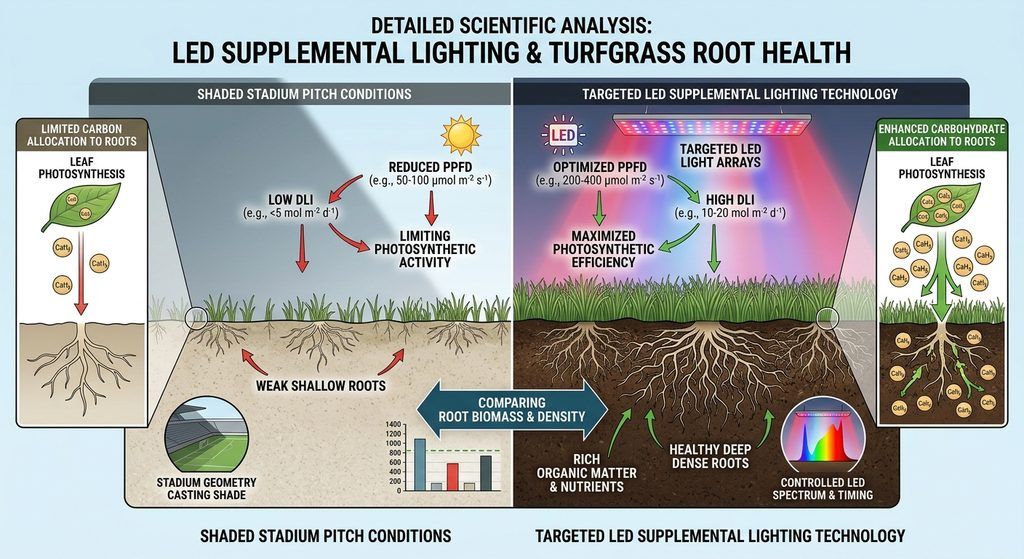
A stronger and more extensive root system can support water and nutrient acquisition and contribute to the plant’s ability to recover between periods of intensive use.
The objective is not to maximise artificial light, but to provide sufficient and appropriate light while avoiding unnecessary energy input.
6. Timing and Spatial Distribution Matter
A stadium pitch does not have one uniform lighting requirement. Stadium geometry, stand shadows, and solar angle can create significant differences in natural radiation across the pitch.
Supplemental lighting should therefore be based on the actual light deficit at canopy level. Combining spatial measurements with PPFD and DLI modelling can identify where additional light is most valuable, creating the basis for targeted rather than uniform lighting.
7. From “More Light” to “Right Light”
The modern approach to stadium turf lighting is to treat light as a biological input rather than simply an engineering parameter.
A scientifically based programme should consider:
- where natural light is insufficient;
- how much PPFD reaches the canopy;
- how DLI varies across the pitch;
- which spectral characteristics are provided;
- when additional light is most beneficial; and
- how the turf responds below the surface.
Root depth, density and biomass should be considered alongside canopy colour, density and NDVI Normalized Difference Vegetation Index), which indicates vegetation health and density.
For intelligent LED systems, this creates an opportunity to move from fixed lighting schedules towards demand-oriented strategies:
Measure → Analyse → Predict → Illuminate → Monitor → Adjust.
8. Conclusion
Healthy stadium turf starts below the surface. Because photosynthesis supplies the resources required for plant maintenance, development and recovery, the root system is closely connected to the light environment.
Insufficient or poorly distributed light can affect root development, recovery and overall turf resilience. LED technology makes it possible to address these limitations with greater spatial, temporal and spectral precision.
The goal is not simply to provide more artificial light, but the right light, in the right place, at the right time — supporting the complete turfgrass plant, including the part that cannot be seen above the surface.