info@rhenac.de
  +49 2242 9061 120
  DE
DE 

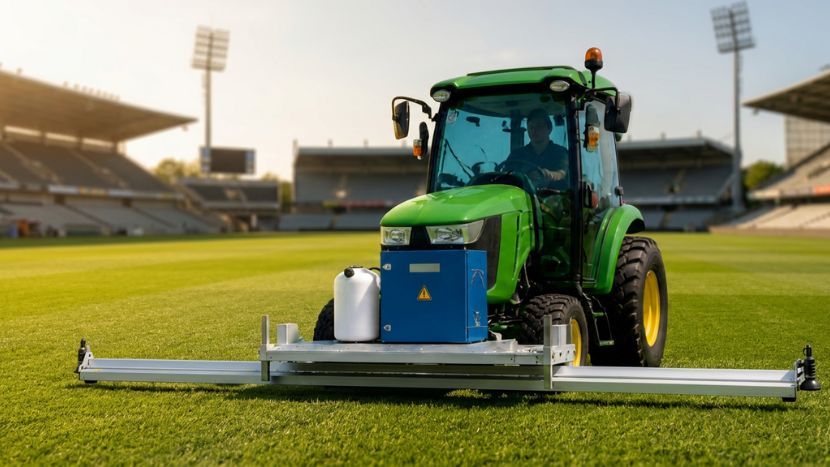
UV-C is increasingly being explored as a preventive tool within integrated turf disease management. In this Q&A, we explain where UV-C acts within the disease cycle, why properly controlled treatment has a limited impact on the soil microbiome, and how it complements LED grow lighting to support healthier, more resilient turf.
Q: How Does UV-C Interrupt the Turfgrass Disease Cycle?
A: Most foliar turfgrass diseases follow the same general infection cycle:
Spore deposition → spore germination → hyphal growth → penetration of the leaf tissue → disease development → sporulation, which produces new spores.
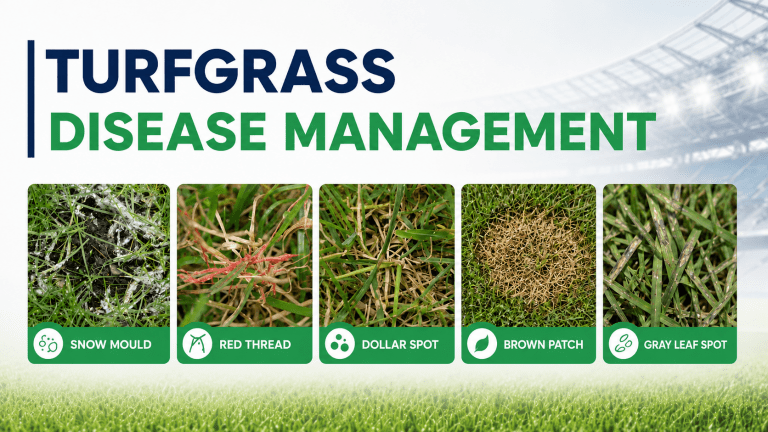
The critical early stages of this cycle occur on the phyllosphere — the leaf surface— where fungal spores land, germinate and begin colonising the plant.
Q: How Does UV-C Interrupt the Disease Cycle Before Infection?
A: UV-C turfgrass disease management acts during these early stages, before the pathogen penetrates the leaf tissue. Exposure to an appropriate and carefully controlled UV-C dose causes DNA damage in fungal spores, preventing them from functioning and reproducing normally.
As a result:
- Spore germination is inhibited.
- Hyphal growth is suppressed.
- The production of new spores is reduced.
- The pathogen is unable to complete its infection cycle.
By disrupting these processes, UV-C helps to prevent successful infection rather than treating an established disease. For this reason, UV-C should be considered a preventive, rather than curative, disease management tool.
Q: Why Does UV-C Not Harm the Soil Microbiome?
A: Soil microorganisms respond differently to UV-C exposure than foliar turfgrass pathogens. Most beneficial microbes are protected within soil aggregates, organic matter and pore spaces, where UV-C radiation cannot penetrate.
In contrast, fungal spores responsible for many turfgrass diseases are exposed on the leaf surface, making them directly susceptible to UV-C irradiation.
In practice, the risk to the soil microbiome is very limited because UV-C has an extremely shallow penetration depth. The radiation acts only on exposed surfaces and does not penetrate the soil profile, where the vast majority of beneficial microorganisms are found.
Consequently, properly applied UV-C primarily affects exposed pathogens on the leaf surface while having minimal impact on the wider soil microbiome.
In addition, soil microbial communities are highly diverse and resilient. Even if a small number of microorganisms at the immediate soil surface are exposed to UV-C, they are rapidly replenished through microbial growth, movement, and recolonization from deeper soil layers. Since UV-C does not penetrate beyond the outermost surface, the overall soil microbiome remains largely unaffected.
Q: Does the UV-C Wavelength Matter?
A: Absolutely. The effectiveness of UV-C turfgrass disease management depends not only on the dose (mJ/cm²) but also on the wavelength.
The germicidal effect is strongest around 260–265 nm, because DNA absorbs UV light most efficiently at these wavelengths.
Many UV-C systems for turfgrass use 254 nm, which is very close to the DNA absorption peak and is therefore highly effective at inactivating fungal spores on the leaf surface.
The selectivity of UV-C in turfgrass management depends where the radiation reaches, rather than on one organism being naturally more sensitive than another. Properly applied UV-C primarily disinfects the exposed phyllosphere while leaving the vast majority of the soil microbiome intact.
When considering UV-C as a way to reduce reliance on fungicides, three factors are particularly important:
- surface-limited exposure
- an appropriate wavelength, typically 254–265 nm
- a carefully controlled dose
Q: How Does UV-C Turfgrass Disease Management Work with LED Grow Lighting?
A: UV-C turfgrass disease management, combined with LED grow lighting, creates an integrated strategy for supporting healthier and more resilient turf.
UV-C helps to reduce pathogen pressure by disrupting the fungal life cycle before infection becomes established.
LED lighting enhances turf vigour by providing the required photosynthetic photon flux density, or PPFD, and Daily Light Integral, or DLI. This supports photosynthesis, carbohydrate production, plant development and recovery from stress.
Together, these technologies can strengthen turf resilience, reduce disease pressure and help decrease reliance on chemical fungicides. They provide grounds teams with a more targeted and sustainable approach to turfgrass disease management, while remaining part of a wider agronomic strategy. When applied correctly, UV-C turfgrass disease management can reduce foliar disease pressure without significantly disrupting the beneficial soil microbiome.