info@rhenac.de
  +49 2242 9061 120
  DE
DE 

Healthy Turf Starts with Understanding Disease
Turfgrass disease management has become an increasingly important aspect of modern stadium turf care. Artificial lighting has significantly advanced stadium turf management, enabling consistent high-quality playing surfaces even in challenging environments. LED systems play a key role in ensuring sufficient and controllable light supply where natural conditions are limited.
At the same time, the introduction of controlled lighting environments adds new agronomic variables that influence turfgrass disease dynamics.
Successful disease management is therefore not simply about controlling pathogens. It requires balancing light, moisture, nutrition, and plant physiology in a coordinated system to support and strengthen the turf’s natural defence mechanisms.
Fundamental Disease Dynamics
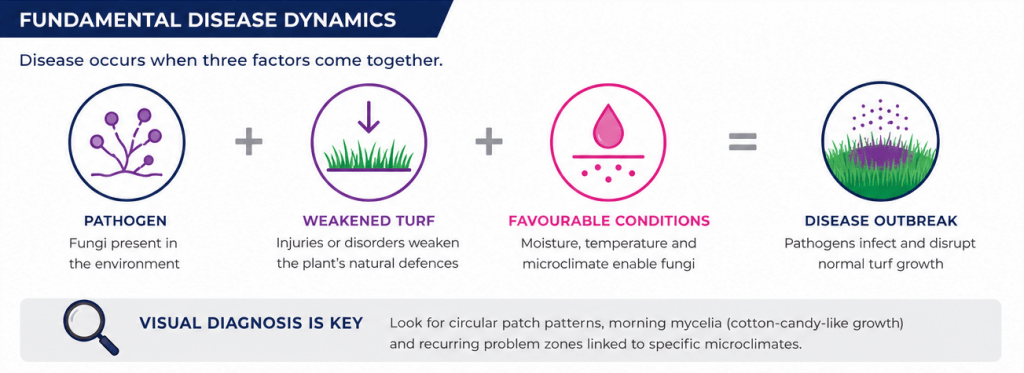
A disease occurs when a biological pathogen (primarily fungi) interacts with the turfgrass to disrupt its normal growth.
However, discoloration does not automatically indicate an active disease. It is important to differentiate between diseases, injuries, and disorders:
- Injuries refer to physical damage such as scalping or herbicide overdoses.
- Disorders describe environmental stresses like drought or nutrient deficiencies.
- Fungal pathogens often exist dormant in the soil and only become active when injuries or disorders weaken the plant’s natural defence mechanisms.
Because fungi are microscopic, visual symptom tracking plays a key role in diagnosis. Typical indicators include circular patch patterns, morning mycelia (cotton-candy-like growth), and recurring problem zones linked to specific microclimates.
The timing of turf inspections is also critical for accurate disease detection. Morning inspections are particularly valuable for identifying fungal activity, as dew creates favourable conditions for visible signs such as mycelium development. In contrast, afternoon or evening inspections can reveal early signs of stress and wilting, which may indicate underlying issues such as root or crown rot.
Turf management practices, including mowing height, also influence disease resistance. Raising the mowing height increases leaf area, allowing the plant to capture more light and produce additional carbohydrates through photosynthesis. This strengthens the turf’s natural defence mechanisms and improves its ability to withstand disease pressure.
The Role of LED Lighting in Disease Management
Artificial lighting changes the turf environment in several important ways:
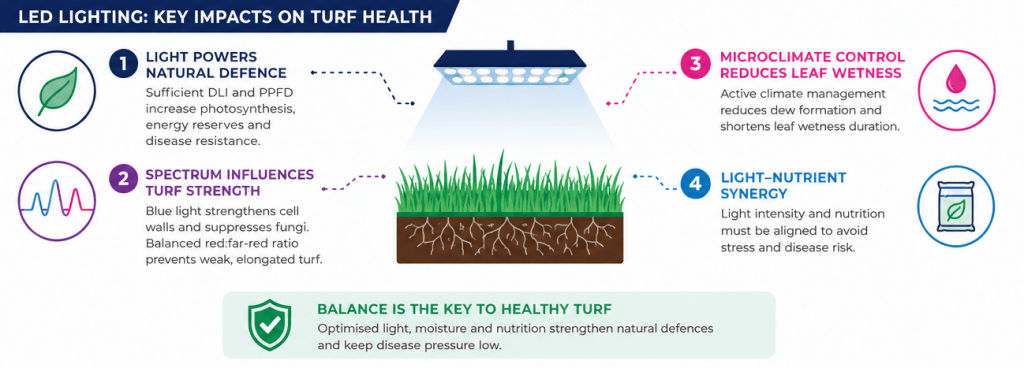
1. Light Powers the Turf’s Natural Defence
Photosynthesis provides the energy required for growth, repair and disease resistance.
When turf receives insufficient Daily Light Integral (DLI) or inadequate Photosynthetic Photon Flux Density (PPFD), carbohydrate production decreases. The plant has fewer energy reserves available to repair damaged tissue and defend itself against pathogens.
2. Light Spectrum Influences Turf Strength
The wavelengths emitted by LEDs influence both plant structure and fungal development:
- Blue light encourages the production of secondary metabolites that strengthen cell walls and naturally suppress fungal growth.
- An imbalanced red to far-red ratio, especially excess far-red light, triggers a shade avoidance response. This results in long, thin, and structurally weaker turf.
- Certain fungi depend on specific blue or near-UV wavelengths for sporulation. Conversely, targeted UV-B or UV-C applications can suppress spore production without the use of chemical fungicides.
3. Microclimates – Dew Point and Leaf Wetness
The duration of leaf wetness is one of the primary drivers of fungal outbreaks.
Unlike natural sunlight or traditional High-Pressure Sodium (HPS) lamps, LEDs do not inherently provide significant radiant heat within the light spectrum itself.
As a result:
- leaf blades may not be continuously warmed through natural radiant heat,
- dew can form more quickly under certain conditions,
- and moisture may remain on the canopy for longer periods.
To manage this, LED-based turf systems require active environmental control. Fans and humidity management are typically used to reduce leaf wetness duration and maintain a balanced canopy climate.
In our integrated turf lighting systems, the lack of natural radiant heat can be actively compensated through infrared heating modules, enabling precise and targeted control of canopy temperature when required, thereby supporting effective moisture management and overall turf stability.
4. The Light–Nutrient Synergy
Nutrient demand, particularly nitrogen, is directly linked to light intensity.
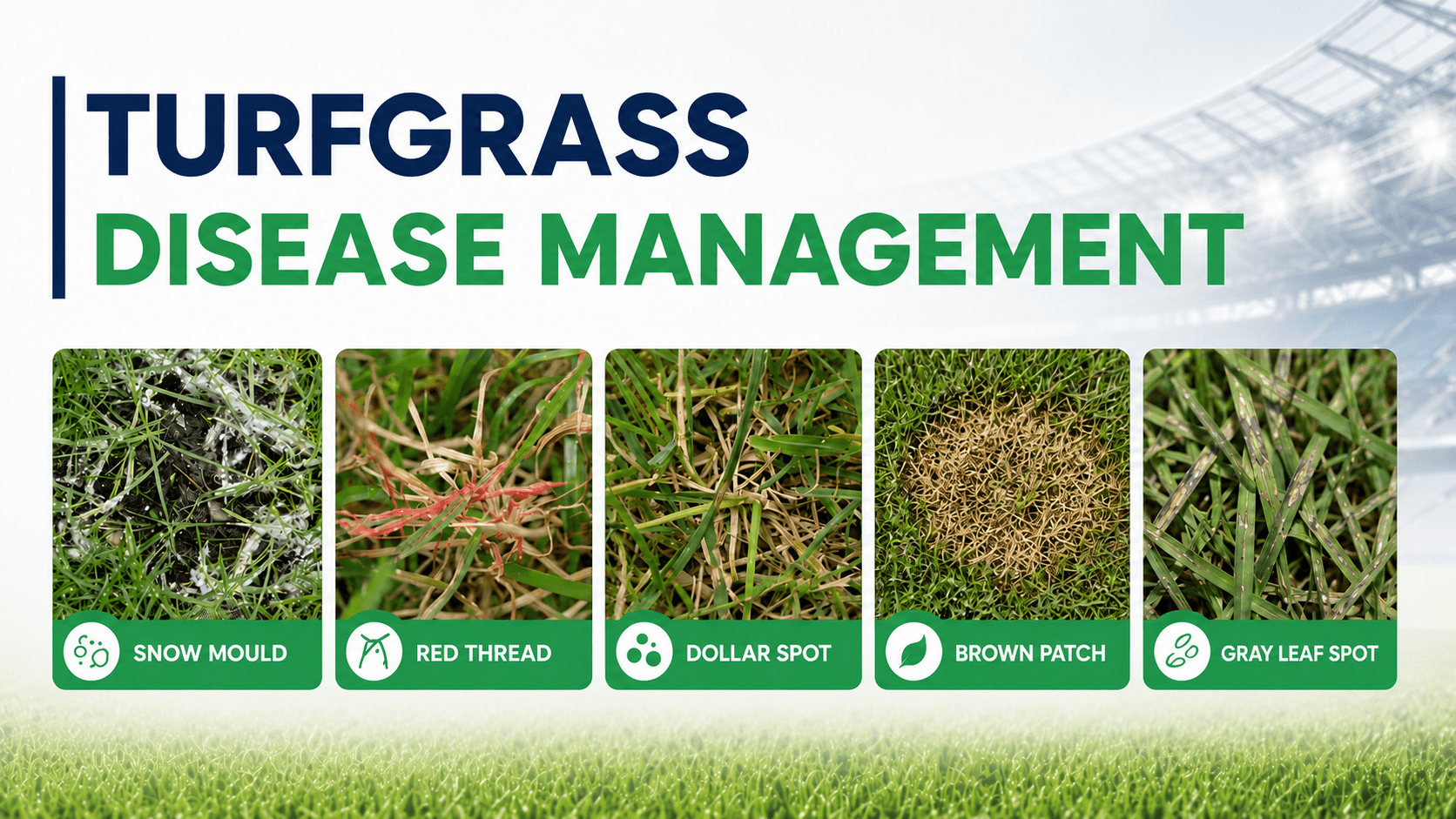
- High PPFD + low nitrogen leads to light stress and nutrient deficiencies, which can trigger diseases such as dollar spot.
- Low PPFD + high nitrogen produces soft, lush tissue rich in free amino acids, making turf more susceptible to diseases like brown patch or gray leaf spot.
For optimal turf health, light delivery and fertilization schedules must therefore be precisely aligned.
Rhenac’s Approach
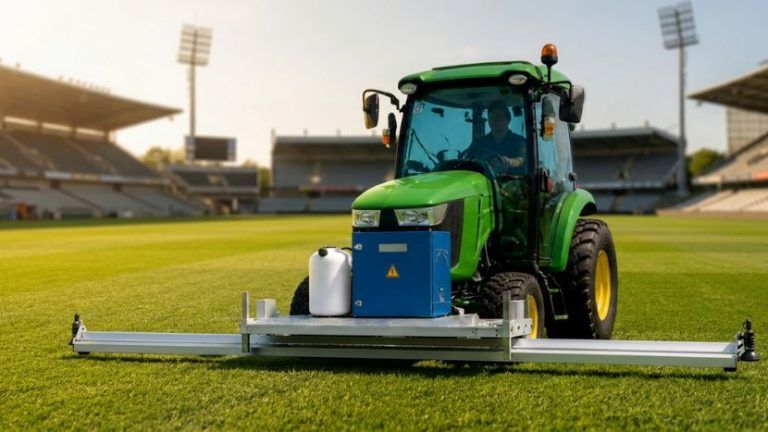
At Rhenac, we recognise that healthy turf depends on far more than light alone. Our integrated approach combines optimised LED lighting, climate management and UV-C technology to address the key factors influencing turf health and disease pressure.
By delivering the right light spectrum and intensity, managing leaf wetness through climate control, and providing chemical-free UV-C disease suppression, Rhenac creates a complete turf management ecosystem that helps stadiums maintain stronger, healthier and more resilient playing surfaces year-round.
Conclusion
Managing turfgrass diseases under LED lighting requires a tightly controlled balance of light spectrum, moisture, and nutrition. When these factors are not aligned, turf becomes more vulnerable to disease development through weakened physiological defence mechanisms and favourable conditions for pathogens.