info@rhenac.de
  +49 2242 9061 120
  DE
DE 

Recognition highlights over a decade of research reshaping how turf is managed in modern stadium environments.
Rhenac has been nominated for the German Innovation Award 2026 for its CLS® (Complete Light Spectrum) system, recognising a long-term research effort into how light influences plant performance in increasingly controlled environments.
Organised by the German Design Council, the German Innovation Award honours innovations that deliver clear added value while contributing to sustainable and forward-looking development across industries. The independent jury brings together experts from business, science and industry, assessing solutions based on their practical relevance and long-term impact. The nomination places CLS® among solutions addressing the practical challenges facing today’s sports venues.
The design and operation of stadiums have evolved significantly in recent years. Enclosed roofs, higher stands and multi-use requirements have reduced natural light availability, while increasing pressure on playing surfaces to perform consistently under intensive use. For many operators, maintaining high-quality natural turf under these constraints has become one of the key operational challenges. In practice, this has created a growing gap between traditional turf management and the realities of today’s venues.
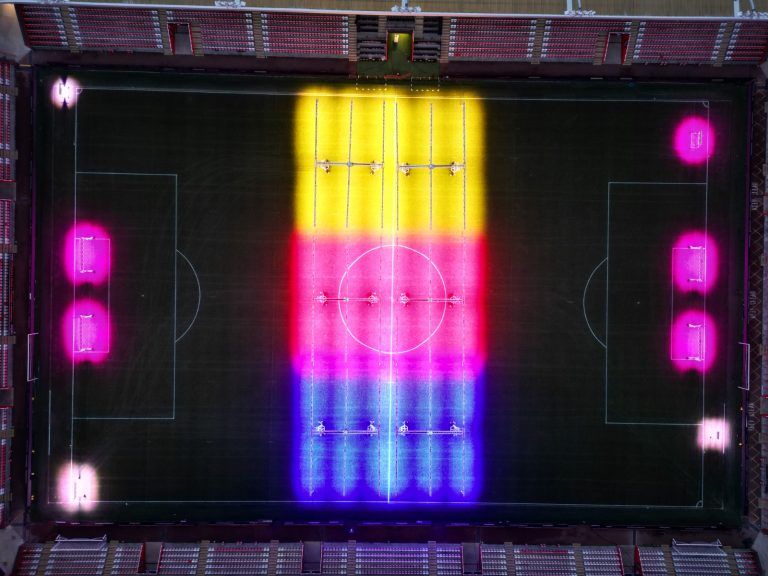
CLS® was developed to address this shift. Rather than applying light based on predefined schedules, the system enables a more responsive approach, where spectrum and intensity are adjusted in relation to plant needs and environmental factors. Developed over more than a decade in collaboration with the Technical University of Munich, the technology reflects a deeper understanding of how turf behaves under different light environments and translates complex plant biology into a practical, repeatable model for day-to-day use. Put simply, it allows grounds teams to make more informed decisions, rather than relying on fixed routines.
As Horst Theisen, CEO of Rhenac, explains:
“This nomination reflects the work of many people over a long period of time — from researchers and engineers to grounds teams working in increasingly complex environments. What has been particularly important is the close collaboration with grounds professionals, whose practical experience and feedback have helped shape how this approach works in real stadium environments. It shows that the way we manage turf is evolving — towards a more precise understanding of how turf performs in controlled settings, and how these can be managed in practice.”
The system is already applied in environments where natural sunlight is limited or absent, including installations such as the underground pitch system at Santiago Bernabéu Stadium and applications at Schalke 04’s VELTINS Arena and Leigh Sports Village. For many in the industry, these are no longer edge cases, but a clear indication of where stadium operations are heading.
By aligning light application with plant needs, CLS® supports a more consistent approach to turf performance and enables a more measured use of resources, as inputs are applied only when they contribute to plant development. As expectations around pitch quality, usage intensity and sustainability continue to increase, this level of precision is becoming essential for maintaining the vitality of natural surfaces.